KS2 French
Our Intent
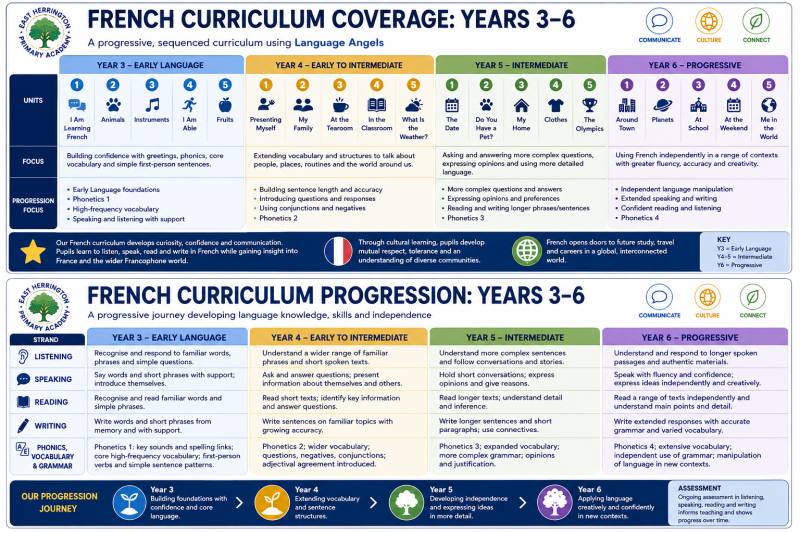
At our school, we want French to inspire curiosity, confidence and an interest in languages and the wider world. Using Language Angels, pupils develop progressively secure knowledge of phonics, vocabulary, grammar and linguistic structures, alongside the skills to listen, speak, read, write and increasingly manipulate language independently, building secure foundations for continued language learning at KS3 and beyond. This reflects the close relationship between substantive and disciplinary knowledge in successful language learning. Our curriculum develops oracy, communication, creativity and independence and enables pupils to appreciate the diversity of France and the wider Francophone world. Through meaningful cultural contexts, pupils develop SMSC, mutual respect, tolerance and an appreciation of different cultures, traditions, families, beliefs and ways of life, supporting their personal development as respectful global citizens. We broaden pupils' aspirations by showing how languages connect to future study, travel and careers, including tourism, hospitality, international business, education, science, media and translation. Where naturally relevant, pupils also consider sustainability, global interdependence and responsible choices.
Our Implementation
French is taught progressively throughout KS2 using Language Angels, moving from Early Language to Intermediate and Progressive learning. Units are deliberately sequenced so pupils continually retrieve and build upon previous phonics, vocabulary, grammar and linguistic structures, enabling learning to move into long-term memory. Retrieval is embedded within lessons and pupils are expected not simply to recall language but to apply it in new contexts. Through regular listening, speaking, reading and writing, pupils develop increasingly accurate pronunciation, fluency and independence. Phonetics 1–4 develops decoding and pronunciation progressively across KS2. Teaching prioritises oracy, interaction and purposeful communication, including questioning, conversation, songs, games, role-play and presentation. Knowledge organisers, glossaries and visual resources support retrieval and independence. The curriculum is ambitious and inclusive. Visuals, dual coding, chunking, oral rehearsal, word banks and appropriately adapted tasks remove barriers while maintaining high expectations. Greater-depth learning develops independence, accuracy and increasingly creative manipulation of familiar language. Cultural learning, SMSC, British Values, careers and personal development are meaningfully connected to appropriate units. Language Angels units are taught through a carefully sequenced series of lessons in which new learning builds upon and retrieves previously taught language. Assessment is ongoing through listening, speaking, reading and writing and is supported by end-of-unit assessment. Teachers use clearly defined unit assessment endpoints to identify pupils working towards, at or beyond the expected standard and to inform subsequent teaching.
The Impact
By the end of Year 6, pupils will have developed secure foundations for KS3 language learning. They will know and remember an increasingly broad range of French phonics, vocabulary and grammar and, importantly, be able to use this knowledge to communicate.
Pupils will increasingly be able to:
- listen and respond to spoken French;
- speak with increasing confidence, fluency and accurate pronunciation;
- read and decode increasingly unfamiliar language;
- ask and answer questions and express and justify opinions;
- construct increasingly detailed spoken and written responses; and
- retrieve and apply previous learning in new contexts.
This reflects the Language Angels ambition for pupils to say more, write more and understand more as their knowledge develops.
Assessment identifies what pupils know, remember and can do across listening, speaking, reading and writing, including their ability to retrieve and apply previous learning independently. This informs subsequent teaching and enables teachers and subject leaders to identify progress over time.. Beyond linguistic knowledge, pupils develop confidence, resilience, communication, independence and cultural awareness. They leave KS2 understanding that languages connect people and cultures and can open opportunities for future study, travel and careers, while developing respect for the diverse and interconnected world in which they live.
Files to Download