Design Technology
Our Intent
At our school, we believe that Design and Technology should provide children with purposeful, real-life contexts for learning. We want pupils to be curious, creative and innovative, developing the confidence to identify problems, explore possibilities and design solutions that meet the needs of others.
Through a carefully sequenced curriculum, children develop the knowledge, skills and understanding needed to design, make and evaluate purposeful products. They progressively explore structures, mechanisms, textiles, electrical systems and food and nutrition, applying their learning through focused tasks and meaningful design-and-make projects. Children are encouraged to experiment, take creative risks, test their ideas and learn from both success and failure, developing resilience, independence and confidence as designers.
We want our pupils to understand that good design considers not only purpose and function, but also people and the planet. Sustainability and climate education are woven meaningfully through our curriculum. Children consider where materials and ingredients come from, how products are produced and the impact that design choices can have on the environment. They explore opportunities to reduce waste and to reuse, repair, repurpose and recycle materials, helping them understand how thoughtful design and technological innovation can contribute to a more sustainable future.
Design and Technology also contributes to pupils’ spiritual, moral, social and cultural development. Through designing for different users and purposes, children learn to consider the needs, values and perspectives of others. Collaborative projects develop communication, cooperation and respect, while exploring products, designers, foods and technologies from different cultures and communities broadens pupils’ understanding of the diverse influences that shape our designed world. Children are encouraged to consider the ethical, social and environmental consequences of the choices designers make.
Our DT curriculum also helps children recognise the connection between their learning and their future possibilities. Through real-life contexts and encounters with designers, makers and professionals, pupils explore how DT knowledge and skills are used across a wide range of careers, including engineering, architecture, construction, product design, textiles, food technology and sustainable design. We challenge stereotypes and ensure children encounter diverse role models so that every pupil can see these opportunities as relevant and achievable.
Ultimately, we want our children to leave primary school seeing themselves as designers, makers and problem-solvers. They should understand that their ideas have value and that, through creativity, technical knowledge and thoughtful decision-making, they can design solutions that positively influence their own lives, their communities and the wider world.
Our Implementation
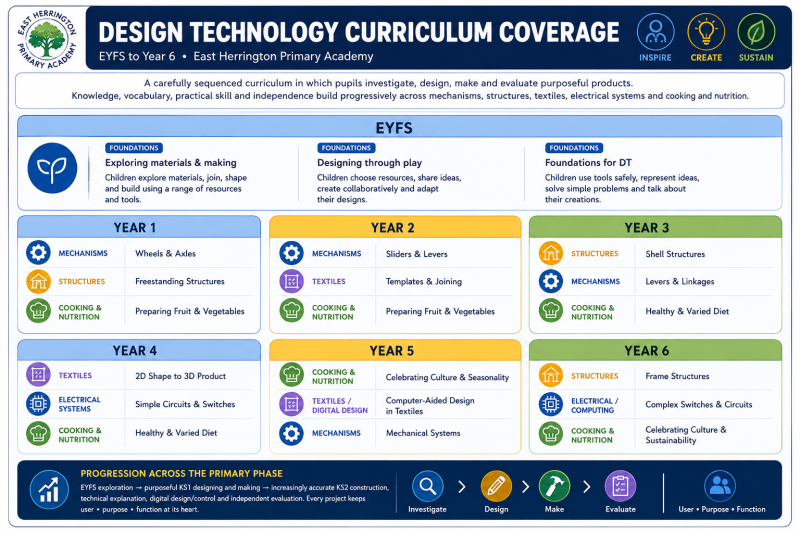
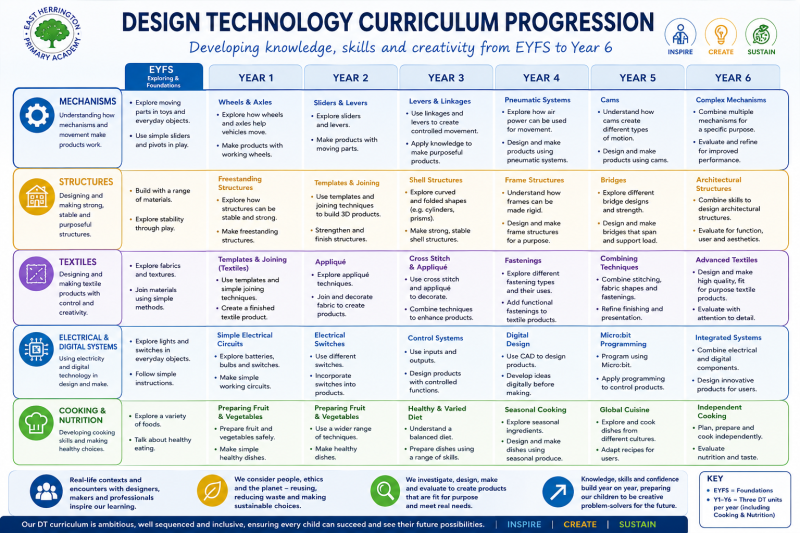
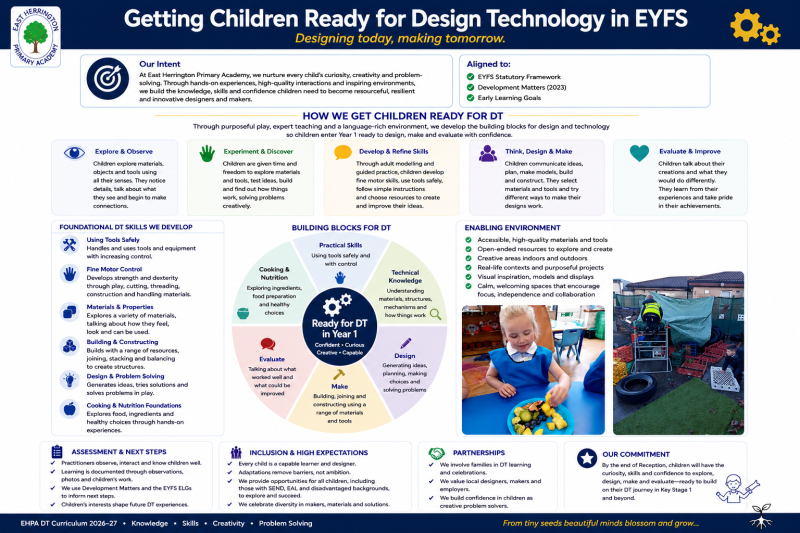
Our DT curriculum is carefully sequenced from EYFS to Year 6, enabling children to progressively build their knowledge, practical skills, technical vocabulary and confidence as designers and makers. Each year group completes three focused DT units, with cooking and nutrition taught progressively throughout school.
Teaching follows the process of investigate, design, make and evaluate. Children explore existing products and undertake focused practical tasks before applying their knowledge and skills to purposeful design-and-make projects. Projects are set within authentic, meaningful contexts, with children considering the intended user, purpose and function of their products.
As children progress through school, they work with increasingly complex structures, mechanisms, textiles, electrical systems and food technologies, developing greater accuracy, independence and confidence in selecting and using appropriate tools, materials and techniques. Opportunities to use digital technology, including CAD and CAM, further develop pupils' understanding of modern design and manufacture.
SMSC, sustainability and climate education are meaningfully embedded within projects. Children collaborate, consider the needs and perspectives of others and explore the cultural, ethical and environmental impact of design choices. They consider responsible use of materials, waste, reuse and recycling and, within food technology, explore seasonality, food origins and locally sourced, organic and Fairtrade ingredients.
Careers education connects classroom learning to the wider world. Through real-life contexts and encounters with designers, inventors, chefs and other professionals, children recognise how DT skills relate to careers in engineering, architecture, construction, product design, textiles, food technology and other STEM and creative industries.
Assessment is ongoing through questioning, observation, discussion, practical outcomes and evaluation. This enables teachers to identify what pupils know, remember and can do, address gaps and ensure learning builds effectively over time.
The Impact
The impact of our DT curriculum is demonstrated through the knowledge, skills, confidence and creativity children develop as designers, makers and problem-solvers.
By the end of primary school, children will:
- Know and remember more, confidently using increasingly sophisticated technical knowledge and vocabulary.
- Design with purpose, considering the intended user, function and design criteria and communicating their ideas through sketches, models, prototypes and digital technologies.
- Make with increasing accuracy and independence, selecting and using appropriate tools, materials, components, ingredients and techniques safely.
- Evaluate and improve, testing products against design criteria, responding to feedback and explaining how designs could be refined.
- Think creatively and solve problems, demonstrating curiosity, resilience and a willingness to experiment and learn from mistakes.
- Make responsible choices, understanding how materials, food sourcing, waste and design decisions can affect people and the planet.
- Develop socially and culturally, collaborating effectively, respecting different perspectives and recognising cultural influences on food, products and design.
- Understand the world of work, recognising how their DT knowledge and skills connect to careers within STEM, creative and design industries.
- See themselves as capable designers and makers, understanding that their ideas can solve problems, meet the needs of others and contribute positively to a more sustainable future.
Files to Download