History
Our Intent
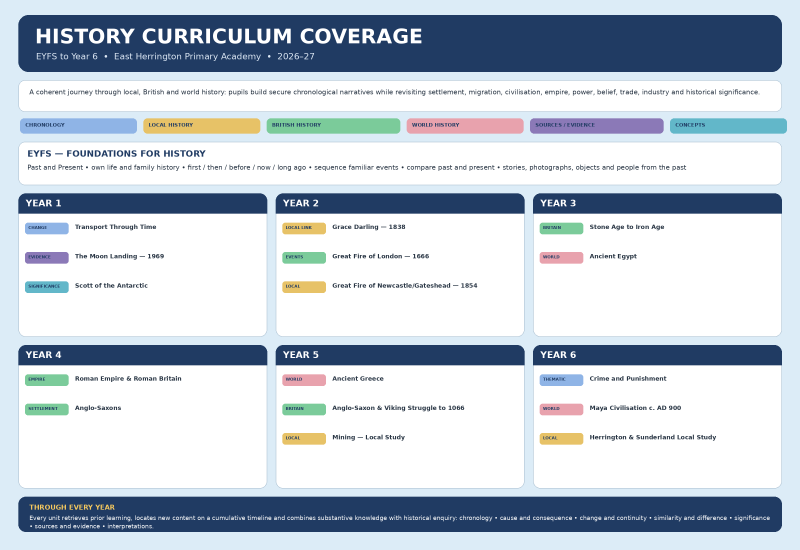
At East Herrington Primary Academy, history develops curious, knowledgeable pupils who can make sense of Britain’s past, the wider world and their own locality through coherent, connected narratives.
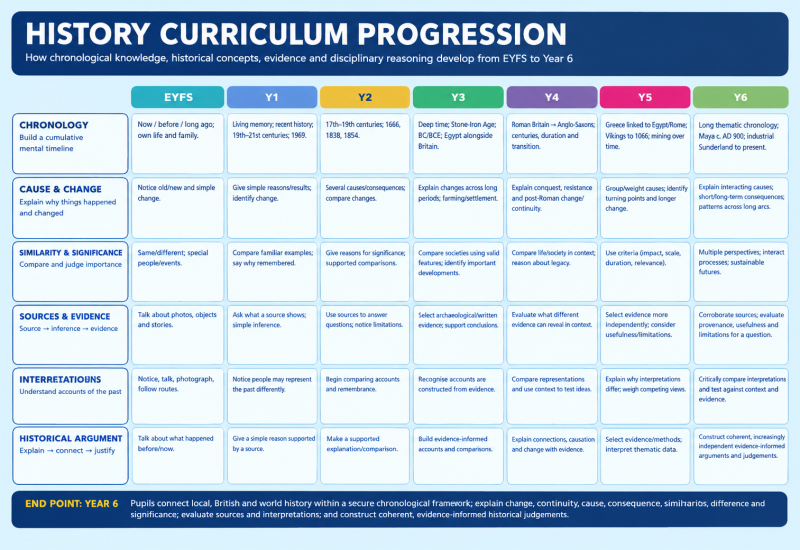
Our curriculum builds secure substantive knowledge alongside disciplinary knowledge: chronology; cause and consequence; change and continuity; similarity and difference; significance; sources and evidence; and interpretations.
Recurring concepts including settlement, migration, invasion, civilisation, empire, power, government, belief, trade and industry are deliberately revisited so pupils can connect learning across time and place.
History contributes strongly to SMSC by exploring identity, belief, diversity, moral choices, community and how societies change. Where historically meaningful, pupils consider relationships between people, resources, environment and climate, including settlement, agriculture, industry and environmental legacy.
Careers are made visible through each unit, linking historical study to archaeology, museums, archives, heritage, conservation, research, journalism, law, tourism and the creative industries, helping pupils see how historical knowledge is used beyond school.
Our Implementation
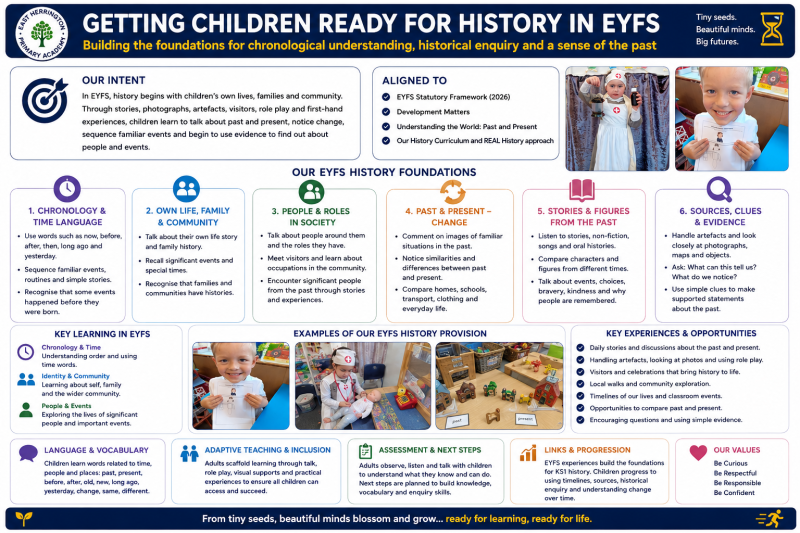
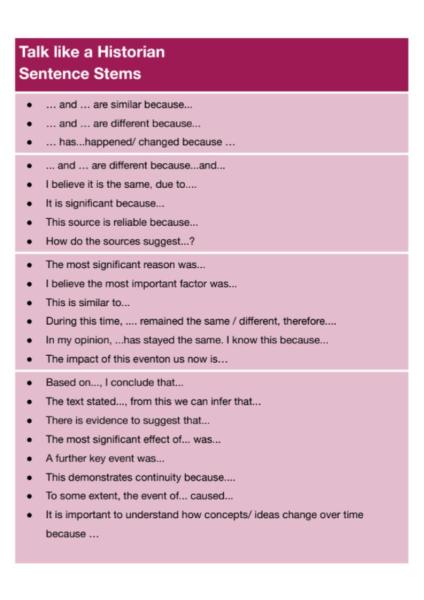
EYFS ‘Past and Present’ establishes the language of time, family history, comparison, sequence and storytelling. KS1 then develops awareness of the past before KS2 builds increasingly secure chronological narratives. The school’s established lesson sequences are retained. Each lesson is strengthened with a focused historical enquiry and an explicit disciplinary purpose, so pupils learn history rather than practise generic skills. Every unit retrieves prior learning, locates new content on a cumulative timeline and revisits substantive concepts. Teachers explicitly model how historians reason from sources, explain causation, compare societies and evaluate interpretations. Vocabulary, visual timelines, artefacts, maps, carefully selected sources, visits and local heritage support long-term memory. SEND adaptations improve access while retaining the same ambitious historical questions and core knowledge. Assessment uses unit endpoints for Working Towards, Expected and Greater Depth and draws on retrieval, discussion, source work and final enquiry outcomes.
The Impact
By Year 6, pupils know and remember essential people, events, developments and concepts and place them within an increasingly secure chronological framework. They make connections across local, British and world history and explain change, continuity, cause, consequence, similarity, difference and significance using increasingly precise historical language. Pupils understand that sources become evidence when used to answer historical questions and that interpretations may differ because historians select, emphasise and interpret evidence differently. They construct increasingly coherent, evidence-informed historical accounts and judgements and can apply prior knowledge to new enquiries. Pupils value their local heritage, understand the diversity and complexity of past societies, recognise meaningful environmental and sustainability connections, and understand the range of careers that use historical knowledge.
Files to Download